Debt snowball vs debt avalanche: which pays off faster?
The debt avalanche (highest APR first) always costs the same or less interest than the debt snowball (smallest balance first), and it is often no slower. The snowball clears your first debt sooner, which research links to staying motivated. If you will stick with either plan, avalanche saves money; if motivation is the risk, snowball can be the better bet.
What the two methods mean
Both methods start from the same rule: pay the minimum on every debt, every month, and put all spare money on one target debt at a time. When the target is paid off, its minimum payment does not disappear. It rolls over to the next target, so your total monthly payment stays the same and the payment on each new target grows. The only difference is the order of the targets.
- Debt snowball: target the smallest balance first, then the next smallest, and so on. The interest rate is ignored when choosing the order.
- Debt avalanche: target the highest APR first, then the next highest. The balance is ignored when choosing the order.
Either method beats paying only the minimums, because the extra money and the rolled-over minimums go straight at the principal of one debt instead of being spread thin.
When each method wins
The avalanche wins on cost. Each extra dollar you pay removes a dollar of balance. Removing it from the debt with the highest APR stops the most interest from building up next month, so with the same budget the avalanche always gives the lowest (or equal) total interest. The gap is small when your rates are close together and large when one debt, usually a credit card, charges far more than the rest.
The snowball wins on early progress. It clears a whole debt sooner. One less account, one less due date, one less statement. If the smallest debt also has the highest APR, the two methods choose the same order and cost exactly the same.
When they tie on time. The total payoff date often lands in the same month, as in the example below. The last debt standing is usually the large, low-rate loan in both plans, and by then all the money is going to it either way. What changes is how much interest you pay on the way there.
Worked example: three debts, $200 extra a month
The numbers below come from a script that uses the same monthly method as our tracker: each month, interest is added first (balance × APR ÷ 12, rounded to the cent), then the minimums are paid, then everything left in the budget goes to the target debt. A cleared debt's minimum rolls over to the next target. Payments start in January 2027.
The debts
| Debt | Balance | APR | Minimum payment |
|---|---|---|---|
| Credit card | $7,800.00 | 24.99% | $195.00 |
| Personal loan | $2,400.00 | 9.5% | $75.00 |
| Car loan | $9,500.00 | 6.9% | $260.00 |
Total debt is $19,700.00. The minimums add up to $530.00, and there is a fixed extra payment of $200.00, so the monthly budget is $730.00 in both plans.
The results
| Plan | Payoff order | Months to debt-free | Last payment | Total interest | Total paid |
|---|---|---|---|---|---|
| Snowball | Personal loan > Credit card > Car loan | 33 | Sep 2029 | $4,366.16 | $24,066.16 |
| Avalanche | Credit card > Personal loan > Car loan | 33 | Sep 2029 | $3,805.57 | $23,505.57 |
| Minimums only (baseline) | No target, no rollover | 87 | Mar 2034 | $10,706.75 | $30,406.75 |
When each debt is cleared
| Debt | Snowball: month cleared | Avalanche: month cleared |
|---|---|---|
| Personal loan | 10 (Oct 2027) | 28 (Apr 2029) |
| Credit card | 29 (May 2029) | 26 (Feb 2029) |
| Car loan | 33 (Sep 2029) | 33 (Sep 2029) |
What the example shows:
- Same finish date, different cost. Both plans are debt-free in month 33, but the avalanche pays $560.59 less interest, because the 24.99% credit card is attacked from the first month.
- The snowball's first win comes much sooner. It clears the personal loan in month 10. The avalanche's first cleared debt is the credit card, in month 26.
- Either plan beats the minimums by a wide margin. Paying only the minimums takes 87 months and $10,706.75 of interest. The extra $200 a month plus rollover cuts 54 months in both plans and saves $6,340.59 (snowball) or $6,901.18 (avalanche) in interest.
Your own numbers will differ, and so may the winner on time. Run both plans with your real balances before you choose.
The behavioural trade-off
If the avalanche is cheaper, why does anyone pick the snowball? Because a plan only works if you keep following it for years, and research suggests that small wins help people keep going.
David Gal and Blakeley McShane of Northwestern's Kellogg School studied records from nearly 6,000 clients of a debt settlement firm (Journal of Marketing Research, 2012). As Kellogg Insight reports, the number of accounts clients closed predicted whether they completed the program better than the dollar amount they had repaid. One of the authors put the trade-off plainly: "From a rational perspective, you should always pay the higher interest balances first," but there is "another factor to consider."
A laboratory study by Alexander Brown and Joanna Lahey (NBER Working Paper 20125) found that people finished a split-up task faster when the parts were ordered from smallest to largest, which supports the "small victories" idea, although participants seldom chose that order for themselves.
There is also evidence that many people follow neither method. In a study of UK credit card holders summarised by the NBER, people with two cards put only 51.5% of their payments above the minimum toward the higher-rate card, when the interest-minimising share was 97.1%. They tended to spread payments in line with the balances instead. Picking either method and sticking to it is already an improvement on that.
A practical way to decide:
- If you are confident you will stay on plan, choose the avalanche and keep the difference in interest.
- If you have started and stopped before, or you have a few small balances that could be cleared quickly, the snowball's early wins may be worth the extra interest. Our example shows how to put a price on that: compare the total interest of the two plans.
- A hybrid works too: clear one tiny balance first for a quick win, then switch to highest APR first.
A note for UK readers
Nothing changes in pounds. Interest is still estimated as balance × APR ÷ 12 each month, minimums still roll over, and the two orders are chosen the same way. HSBC UK's debt guide describes the same two options: paying the highest interest rate first is typically cost-effective, while clearing small balances first can give a psychological boost. If you have a 0% balance transfer card, the avalanche puts it last because it costs nothing while the offer lasts. Keep paying its minimum and note the date the promotional rate ends.
Real lenders often charge interest daily and may add fees, so any monthly model is an estimate. Update your balances from your statements every few months.
Run both plans with your own numbers
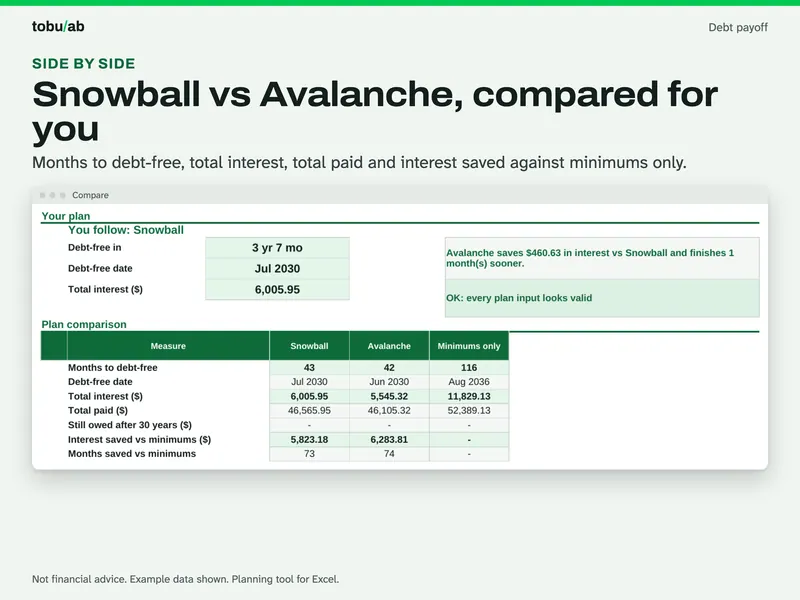
Our Debt Payoff Tracker takes up to 10 debts and shows snowball and avalanche side by side, plus a minimums-only baseline: months to debt-free, debt-free date, total interest, interest saved and the payoff date of every debt. It flags any minimum payment that does not cover the interest. It has no macros. Scripts recalculated it in Excel for Mac 16.114.3 and LibreOffice, and Google Sheets has not been tried.
To plan your monthly spending as well, the Budget + Debt Payoff Bundle adds a full-year zero-based budget spreadsheet, and the UK Budget + Debt Payoff Bundle is set up in pounds with UK example categories.
Planning tool, not financial or tax advice.
Questions
- Is the debt avalanche always cheaper than the debt snowball?
With the same monthly budget, putting extra money on the highest APR first gives the lowest or equal total interest. When your smallest debt also has the highest APR, both methods pick the same order and cost the same.
- Does the snowball method get me out of debt later?
Not always. In our worked example both plans finish in month 33; the avalanche simply pays less interest. With larger rate gaps or longer timelines the avalanche can also finish a little sooner.
- What happens to a minimum payment when a debt is paid off?
In both methods it rolls over: the freed-up minimum is added to the payment on the next debt in your order, so your total monthly payment stays the same until everything is cleared.
- Should I include a 0% debt in the plan?
Yes, keep paying its minimum. The avalanche puts a 0% debt last because it costs no interest. Check when any promotional rate ends, because the APR will change then.
- Does this work for UK debts in pounds?
Yes. The method only uses balances, APRs and minimum payments, so the maths is the same in GBP, USD or any other currency.
Sources
- Kellogg Insight: To Beat Debt, Consider Starting Small (Gal & McShane, Journal of Marketing Research, 2012)
- NBER Working Paper 20125: Small Victories: Creating Intrinsic Motivation in Savings and Debt Reduction (Brown & Lahey)
- NBER Digest: Paying Down Credit Card Debt in Suboptimal Ways (Gathergood, Mahoney, Stewart & Weber)
- HSBC UK: How to get out of debt, repaying debt
Updated 2026-10-26 · by tobulab